
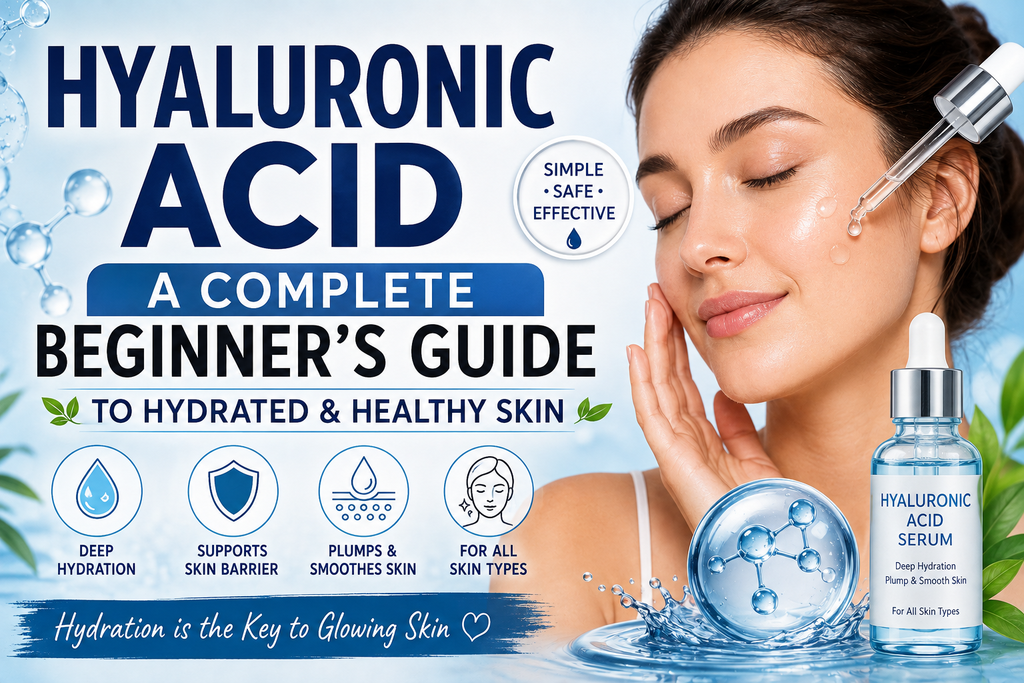
Hyaluronic Acid: A Complete Beginner’s Guide to Hydrated and Healthy Skin
Introduction
Hyaluronic Acid is one of the most popular ingredients in modern skincare, especially for people who want soft, smooth, and hydrated-looking skin. It is commonly found in serums, moisturizers, creams, and other skincare products.
Unlike exfoliating acids such as glycolic acid or salicylic acid, Hyaluronic Acid is primarily known as a humectant that helps attract and retain water in the skin. Research supports its role in improving skin hydration and overall skin appearance when used topically.
In this beginner-friendly guide, you will learn:
- What Hyaluronic Acid is
- Why Hyaluronic Acid is used in skincare
- How to use it correctly
- Which skin types can benefit from it
- Which ingredients work well with it
- Common mistakes to avoid
What Is Hyaluronic Acid?
Hyaluronic Acid is a naturally occurring substance found in the human body, including the skin. It has a strong ability to hold water, which is why it is widely used as a moisturizing ingredient in skincare products.
In skincare, Hyaluronic Acid works mainly as a humectant. This means it helps attract and retain water around the skin’s surface.
It is important to understand that Hyaluronic Acid is not primarily an exfoliating ingredient. Instead, its main purpose is to support hydration and give skin a more comfortable, smooth, and plump-looking appearance.
Hyaluronic Acid vs. Harsh Active Ingredients
| Hyaluronic Acid | Strong Active Ingredients |
|---|---|
| Mainly supports hydration | Often target specific skin concerns |
| Usually gentle | May cause irritation in some people |
| Common in serums and moisturizers | Often used in treatment products |
| Helps improve skin moisture | May exfoliate or increase cell turnover |
| Beginner-friendly | May require slower introduction |
Why Is Hyaluronic Acid Important?
Healthy-looking skin needs adequate hydration. When the skin becomes dry or dehydrated, it may look dull, rough, or uncomfortable.
Hyaluronic Acid can help increase the water content of the skin, making it a useful ingredient for maintaining a hydrated appearance. Studies of topical Hyaluronic Acid products have reported improvements in skin hydration, smoothness, and plumping.
Potential Benefits of Hyaluronic Acid
- Helps improve skin hydration
- Can make skin feel softer and smoother
- Supports a plumper-looking appearance
- May reduce the appearance of dryness-related fine lines
- Can complement a simple skincare routine
- Generally works well with many other skincare ingredients
A clinical study of a topical Hyaluronic Acid serum found significant improvements in measured skin hydration along with improvements in smoothness and plumping during the study period.
Hyaluronic Acid: A Complete Beginner’s Guide to Hydrated and Healthy Skin
Signs That Your Skin May Need More Hydration
Not every skin concern is caused by dehydration, but several common signs may suggest that your skin could benefit from more moisture.
Common Signs of Dehydrated Skin
- Tight feeling after cleansing
- Dry or rough texture
- Dull-looking skin
- Fine lines that appear more noticeable
- Skin that feels uncomfortable after washing
- Makeup sitting unevenly on the skin
Dehydrated skin can occur in different skin types, including oily skin. This is why oily skin can still benefit from a lightweight hydrating product containing Hyaluronic Acid.
Hyaluronic Acid Skincare Routine for Beginners
A simple routine is usually easier for beginners to maintain. Hyaluronic Acid can be added to both morning and evening skincare routines.
Step 1: Use a Gentle Cleanser
Start with a gentle cleanser to remove sweat, dirt, sunscreen, and excess oil.
Avoid cleansing too aggressively because over-cleansing may leave your skin feeling dry and uncomfortable.
Look for:
- Gentle cleansing agents
- A non-stripping formula
- A texture suitable for your skin type
- Fragrance-free options if your skin is easily irritated
Cleanse your face according to your skin’s needs rather than repeatedly washing throughout the day.
Step 2: Apply Hyaluronic Acid
After cleansing, apply your Hyaluronic Acid serum or hydrating product.
A useful beginner approach is to apply it to slightly damp skin, followed by a moisturizer. This helps create a simple hydration-focused routine.
Basic order:
Cleanser → Hyaluronic Acid → Moisturizer
Step 3: Use a Moisturizer
Hyaluronic Acid adds hydration, but a moisturizer can help support that hydration by adding emollient and barrier-supporting ingredients.
Choose your moisturizer based on your skin type.
- Dry skin: richer cream
- Oily skin: lightweight gel or lotion
- Combination skin: lightweight moisturizer
- Sensitive skin: simple fragrance-free formula
Step 4: Apply Sunscreen
During the morning, finish your routine with sunscreen.
Daily sun protection is an important part of maintaining healthy-looking skin. Your Hyaluronic Acid serum should not be considered a replacement for sunscreen.
Step 5: Keep Exfoliation Moderate
Hyaluronic Acid is not an exfoliant, so it can be useful when your routine already contains exfoliating ingredients.
However, using too many strong active products at once can make your routine unnecessarily complicated.
A simple routine is often easier to manage:
Cleanser → Hydrating product → Treatment, when needed → Moisturizer → Sunscreen
Hyaluronic Acid: A Complete Beginner’s Guide to Hydrated and Healthy Skin
Best Ingredients to Use With Hyaluronic Acid
Hyaluronic Acid can easily fit into many skincare routines. Here is a useful ingredient chart for beginners:
| Ingredient | Main Benefit | Works Well With Hyaluronic Acid |
|---|---|---|
| Glycerin | Hydration | Yes |
| Ceramides | Skin barrier support | Yes |
| Panthenol | Soothing and hydration | Yes |
| Niacinamide | Supports skin appearance and barrier | Yes |
| Squalane | Moisturization | Yes |
| Vitamin C | Antioxidant support | Yes |
| Peptides | Skin-conditioning support | Yes |
| Salicylic Acid | Exfoliation | Can be combined carefully |
| Retinoids | Skin renewal | Can be combined with hydration support |
Using Hyaluronic Acid alongside moisturizing and barrier-supporting ingredients can make a routine more hydration-focused and comfortable. Different forms and molecular weights of Hyaluronic Acid are used in cosmetic formulations, with different effects on the skin surface and deeper layers.
Hyaluronic Acid According to Your Skin Type
Dry Skin
Dry skin often benefits from a combination of hydration and moisturization.
Try:
- Gentle cleanser
- Hyaluronic Acid serum
- Rich moisturizer
- Daily sunscreen
Hyaluronic Acid can help increase hydration, while a moisturizer helps support comfortable, moisturized skin.
Oily Skin
Oily skin can still become dehydrated. Instead of avoiding hydration completely, choose lightweight products.
Try:
- Gentle cleanser
- Lightweight Hyaluronic Acid serum
- Gel moisturizer
- Non-greasy sunscreen
Combination Skin
Combination skin benefits from balance.
Use lightweight hydrating products and adjust your moisturizer based on which areas feel dry or oily.
Sensitive Skin
Sensitive skin often benefits from a simple routine with fewer unnecessary ingredients.
Look for:
- Fragrance-free options
- Simple formulas
- Gentle cleansers
- Hydrating products
- Barrier-supporting moisturizers
Introduce new products one at a time and monitor how your skin responds.
Morning vs. Night Hyaluronic Acid Routine
| Morning | Night |
|---|---|
| Gentle Cleanser | Gentle Cleanser |
| Hyaluronic Acid | Hyaluronic Acid |
| Moisturizer | Moisturizer |
| Sunscreen | — |
You do not necessarily need a complicated routine to benefit from Hyaluronic Acid. Consistency is often more useful than using many products at once.
Common Hyaluronic Acid Skincare Mistakes to Avoid
Even a gentle ingredient can be used incorrectly. Avoid these common mistakes:
- Applying too much product
- Skipping moisturizer after a hydrating serum
- Using too many skincare products together
- Expecting Hyaluronic Acid to treat every skin problem
- Repeatedly changing products
- Ignoring sunscreen during the daytime
- Choosing a product without considering your skin type
Remember that hydration is only one part of skincare. Acne, pigmentation, irritation, and other concerns may require different ingredients or professional guidance.
Hyaluronic Acid Tips for Beginners
If you are new to Hyaluronic Acid, start with a straightforward routine.
Simple Tips
- Introduce one new product at a time
- Follow the product’s directions
- Apply a small amount
- Use moisturizer after your hydrating serum
- Use sunscreen in the morning
- Give your routine time to work
- Stop using a product if it causes persistent irritation
- Patch test when appropriate
The goal is not to use the maximum number of products. The goal is to create a routine that your skin can comfortably tolerate and that you can consistently follow.
How SkinHydrova Can Help
At SkinHydrova, skincare can be made easier for beginners by focusing on simple product choices and understandable routines.
A beginner-friendly approach can include:
- Easy-to-understand skincare products
- Hydration-focused options
- Products organized by skin type
- Guidance for building simple routines
- Educational content about common skincare ingredients
The aim should be to help people understand what they are applying to their skin instead of encouraging unnecessarily complicated routines.
Frequently Asked Questions About Hyaluronic Acid
What is Hyaluronic Acid?
Hyaluronic Acid is a naturally occurring substance that can hold water and is widely used in skincare as a hydrating humectant.
Is Hyaluronic Acid good for sensitive skin?
Many topical Hyaluronic Acid formulations are well tolerated, making the ingredient a common choice for hydration. However, the complete formula matters, and people with sensitive skin should introduce new products carefully.
Can oily skin use Hyaluronic Acid?
Yes. Oily skin can still become dehydrated. Lightweight Hyaluronic Acid serums can provide hydration without requiring a heavy texture.
How often should I use Hyaluronic Acid?
Many Hyaluronic Acid products are designed for daily use, including morning and evening. Always follow the directions of the specific product you are using.
Should I apply Hyaluronic Acid before moisturizer?
Yes. A common routine is cleanser, Hyaluronic Acid serum, moisturizer, and sunscreen in the morning.
Can I use Hyaluronic Acid with niacinamide?
Generally, yes. Hyaluronic Acid and niacinamide are commonly included in the same skincare routine because they serve different roles and can complement a hydration-focused routine.
Can I use Hyaluronic Acid with salicylic acid?
They can be used together in many routines. Salicylic Acid is an exfoliating ingredient, while Hyaluronic Acid mainly provides hydration. Adding a hydrating step may help keep a routine more comfortable, but introduce products gradually if your skin is sensitive.
Conclusion
Hyaluronic Acid is a popular skincare ingredient because of its ability to support skin hydration. It can be a useful addition to simple routines for dry, oily, combination, and many sensitive skin types.
The best way to use Hyaluronic Acid is to keep your routine simple and consistent.
Start with:
Gentle Cleanser → Hyaluronic Acid → Moisturizer → Sunscreen
With the right products and regular use, a hydration-focused routine can help your skin look softer, smoother, and more comfortable. Rather than chasing complicated skincare trends, focus on understanding your skin type, choosing suitable products, and protecting your skin every day.